
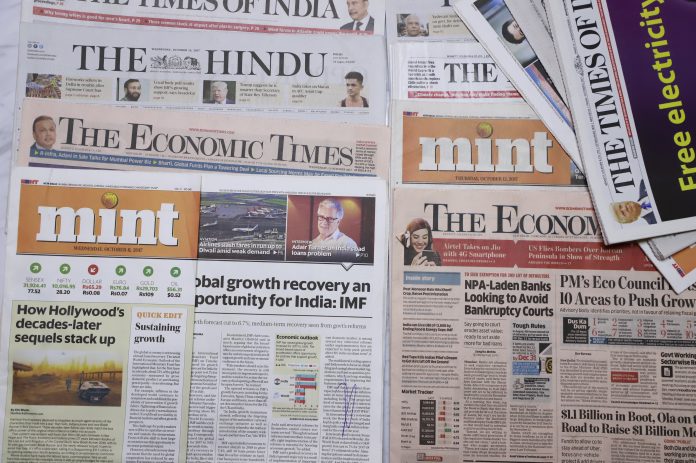
New Delhi: From readers’ fear of physically picking up copies, to newspaper vendors being denied entry into residential complexes to advertisers withdrawing ads, the newspaper industry has been facing demand, supply and logistics-related challenges ever since the outbreak of the novel coronavirus.
In Delhi, the print orders of two major newspapers have allegedly dwindled from around 14 lakh each to just about one lakh while some smaller newspapers, which have witnessed a sharp decline in circulation, have already announced major salary cuts.
Recently, a video showing a woman picking up a newspaper with a pair of tongs and then proceeding to iron it went viral. While the anecdote may have amused some, the fear that newspapers may bring one into contact with the dreaded virus is real for many. Newspaper vendors who spoke to The Wire said that many readers had either been cancelling their orders or had proceeded to reduce them.
Ved Prakash Mishra, who has been in the business of distributing papers in the Lodhi Road area of New Delhi for over three decades now, said that sales had dropped sharply. What has also hit the vendors hard is that many government colonies and private apartment blocks have stopped the entry of vendors altogether.
‘Out of bounds’
“We can no longer go into Jor Bagh. We were distributing around 800-900 copies there regularly. We used to distribute a number of copies at the staff quarters at the Air Force Bal Bharti School, but we can no longer enter the premises now. So is the case at Mausam Bhawan, which houses a large number of employees of the India Meteorological Department. We used to distribute over 300 copies in the staff quarters there, but now we are not allowed any access,” said Mishra.
Insisting that the process of printing of newspapers was sanitised, automated and required little handling by the hand, he said, “We know that the chances of transmission of any virus through a newspaper are minimal, but people are just not prepared to listen”.
IIT bars entry of newspaper vendors
A few kilometres down the road, at IIT Delhi as well, the entry of newspaper vendors has been barred. Here, the security officer had, on March 29, sent a message to all the teachers, staff and students that read: “Due to alarming situation of the spread of coronavirus, many of us have stopped the newspaper delivery. Now the institute has decided to stop the entry of newspaper hawkers into the campus.”
While some professors squirmed at the idea and found it to be “out of its character” for an institution like IIT, the situation on ground has remained the same. No papers are being allowed in. Newspaper delivery has taken a hit at the nearby NCERT campus too, as most of the readers have cancelled their copies. Manoj Sharma, a newspaper vendor, said that it would be better if the business was shut altogether as vendors sometimes had to bear the loss of unsold copies.
Vendors across the National Capital Region are facing similar grim situations. At Indirapuram in Ghaziabad, Rintu Kumar, a vendor, said most of the society apartments had stopped allowing newspaper vendors inside their complexes. “We are only able to sell a few copies at the builder flats. There too, we now bind the copy with a rubber band and lob it into the balcony. No one takes it by hand.”
Newspapers being sent on demand to distribution points
Stating that the distribution had been reduced to a tenth of what it earlier was, Kumar said the two major English newspapers were still sending copies as annual subscription orders for them had been taken in advance. “But now even their personnel first call up and ask over the phone as to how many copies we will lift. They only send copies as per the demand. The supply of smaller newspapers and the vernacular dailies has almost dropped to nil.”
In other major cities as well, the newspaper distribution business is under severe stress. A vendor in Mumbai, who gave his name as Yadav, said, “even if I wanted to deliver newspapers, how will I get to the distribution centres? There are no suburban train services.”
“Many vendors are concerned about lifting the newspapers because we fear contracting the virus ourselves. Soon after the news of the outbreak started circulating, many of my customers called to say that they did not want any more newspapers. I don’t know if they will take after the whole thing is over,” said Yadav.
Print orders drop by up to 90%
The fall in sales, as well as the impact of the coronavirus outbreak on the economy overall, has hit the advertisement revenues of newspapers hard. “There are massive cancellation orders for advertisements. The revenue of newspapers is taking a hit from both the advertising and circulation side,” said a senior manager of a national daily.
“In Delhi, two major newspapers have reduced their print orders to just about one lakh each from around 14 lakh each earlier. Another newspaper, which was printing around 1.5 lakh copies earlier, is now printing around 15,000 copies only. At one point in time, its print order had come down to just 5,000,” he said.
Salary cuts at print newspapers
The financial crisis has also made some national dailies announce salary cuts. The Indian Express recently announced a graded salary cut for its employees under which a reduction of between 10% and 30% in salaries has been announced for various categories of employees while the editors and senior management have decided to take a 100% salary cut. Only employees drawing less than Rs five lakh have been left out of this cost-cutting drive.
However, as the threat from coronavirus is expected to last for a while, the entire industry is bracing for tougher days ahead.
Another hurdle for the newspaper industry is that elderly persons, who constitute a big share of readers, are adversely impacted by the coronavirus.
While many of the younger readers prefer to access content online over phones, tablets or computers, it was the older demographic that was still in the habit of picking up a copy of the newspaper first thing in the morning. With these loyal readers now drifting away, the print newspaper industry has little left to rely on.

COVID-19 Makes Readers, Advertisers Wary, Newspapers Slash Editions, Salaries to Cope added by Muslim Kashmir on
View all posts by Muslim Kashmir →